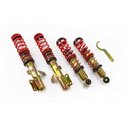
- Online only
- New


Your motorsport parts store.
Service exclusively for customers of this website.
Under Royal Decree 750/2010 any modification of the vehicle's suspension system made after its first registration must be legalised by including it in the technical data sheet.
Even if the ITV station does not ask for it during the routine inspection, this does not mean the vehicle can be driven legally, and it may cause a serious problem in the event of an accident involving the vehicle.
The project can be carried out at any time after the suspension has been purchased, but once processed it is valid for 30 days to attend the ITV.
The project consists of:
Once the order has been placed, log in to your user panel and open your order: you will find a downloadable guide that you must print and fill in step by step.
It is very easy: once your springs or suspension kit are fitted, ask the installing workshop for the details shown on the workshop certificate and attach them with the rest of the documentation we request.
Once the project has been prepared, take the certificate to the workshop to have it stamped (print it, have it stamped, and keep it for the ITV).
During installation, it is useful to take photographs of the installed components so that the spring references are visible.
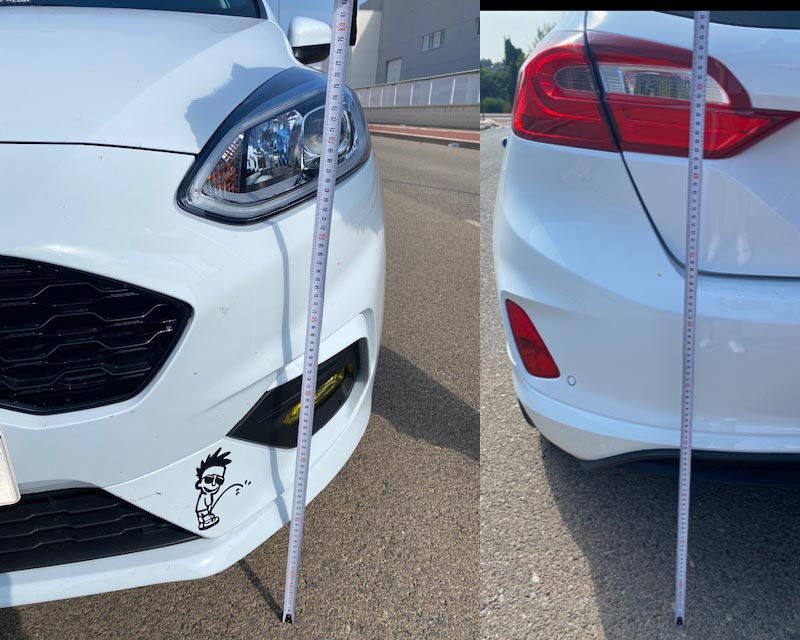
We will also need photographs of the vehicle on flat ground: a full side view, the front and the rear (with the number plate always visible), as well as front and rear photographs with a measuring tape so that the measurements are clearly visible.
Example photos:
You must fill in the attached form, which includes the vehicle height and other additional details.
Once you have everything, send all the documentation in a single file by email to homologaciones@rodiautosport.es
Required documentation:
If the spring or threaded kit does not have TUV certification, the measurements must be taken as follows:

The vehicle height must be measured exactly as at the ITV:

If the measurements do not meet any of these requirements, the modification cannot be legalised.
|
MINIMUM HEIGHTS |
|
Lower edge height of rear fog light ≥ 250 (mm) |
|
Lower edge height of front fog light ≥ 250 (mm) |
|
Lower edge height of dipped headlight ≥ 500 (mm) |
|
Lower edge height of front indicators ≥ 350 (mm) |
|
Lower edge height of brake light ≥ 350 (mm) |
|
Lower edge height of front position light ≥ 350 (mm) |
|
Lower edge height of rear position light ≥ 350 (mm) |
|
Lower edge height of rear indicators ≥ 350 (mm) |
|
Lower edge height of rear reflectors ≥ 250 (mm) |
|
Lower edge height of daytime running light (if fitted) ≥ 250 (mm) |
|
Lower edge height of reversing light ≥ 250 (mm) |
|
Lower edge height of rear number plate ≥ 300 (mm) |
We will not accept homologation requests that do not include all the documentation at once.
If the file is too large, you can use a free file transfer server -> Wetransfer
The project is then drafted and sent to the laboratory for the final certificate.
Once obtained, it is sent electronically to the customer, who forwards it to the ITV where the new vehicle height will be regularised, needing to take only the workshop certificate in physical form.
If the springs do not have TUV certification, or have it but the references are not visible due to wear or rust, it may be necessary to remove the springs to measure their length without compression.