- New
€13.02€33.02
€13.02€33.02Regular price-€20.00 offPrice
- New
- On sale!
Your motorsport parts store.

In regions with frequent harsh winters it is common to fit winter tires, but in Spain, for occasional spells of intense cold, the most common choice is to carry snow chains.
Driving on icy or snowy roads without snow chains can cause a loss of tire grip, resulting in a lack of steering and braking.
Whatever type of snow chain you are going to fit, remember that they must always be fitted to the drive wheels.
Another important detail to bear in mind is that snow chains must only be fitted when the road is covered with snow or ice, to prevent the chains from damaging the tire and the wheel. Don't forget to keep a pair of gloves in the car! Your hands will thank you.
If you are going to travel and expect snow, we recommend practicing fitting the snow chains beforehand so you are not caught off guard.
Inexperience, nerves and the cold can make fitting them much harder.
In this video you can see how to fit them:
There are several options for setting off on icy or snowy roads. Let's review each one so you can choose the most suitable.
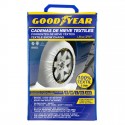
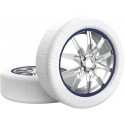
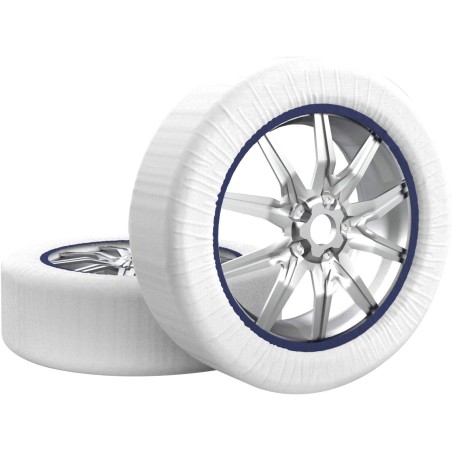
Fabric snow socks take up little space in the trunk, are useful for short trips and can be washed and dried.
Fabric snow socks offer high abrasion resistance even on minivans and extra driving comfort, as they avoid vibrations.
They do not damage the wheel, but on the downside they wear out faster. Do not exceed the speed recommended by the manufacturer so as not to reduce their durability.
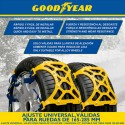
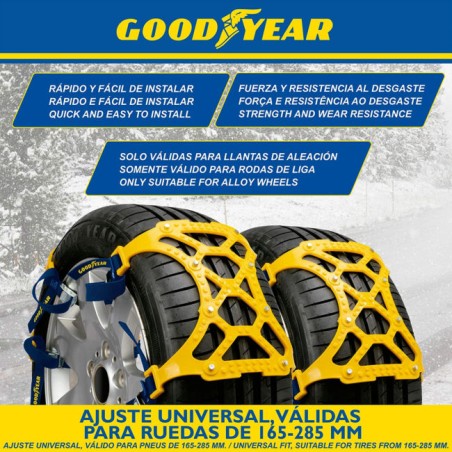
These are the most widely used, the classic ones with metal or plastic links, as they offer the best effectiveness-to-price ratio.
They provide safe driving on snow or ice and are the most affordable, but on the downside they are harder to fit, heavy, noisy on the road and not compatible with the correct use of stability control (ESP). Driving with them without snow is not recommended, as they damage the tire and the wheel.
Although they are called liquid chains, they are actually a spray applied to the tire tread to increase grip at a specific moment.
They are not valid when the traffic authorities require traditional chains.
4 products